
Philosophy Paper #3 Justice Virtue Analysis
Shane F.
Economics Student
SBS 370: Toward A Global Ethics // Analytic Methods & Practical Skills III
February 24th, 2026
Introduction
Philosophy allows us to ask introspective questions about the world in which we’re a part. Many of these questions are of the utmost importance, however, with all the massive technological advances and productivity leaps made within the past hundred years, a critical question arises from these circumstances. In the face of unprecedented technological, environmental, and social shifts, where does humanity currently stand as a global society, what historical forces have driven us here, and how must we restructure our inequitable economic systems and governance models to ensure a sustainable and just future? These exceedingly difficult and uncomfortable questions are the exact types of questions that we must ask ourselves, but paradoxically these questions are among the least explored questions in a modern person’s distracted, predetermined dysfunctional, and systematically hopeless mind.
Macro Analysis
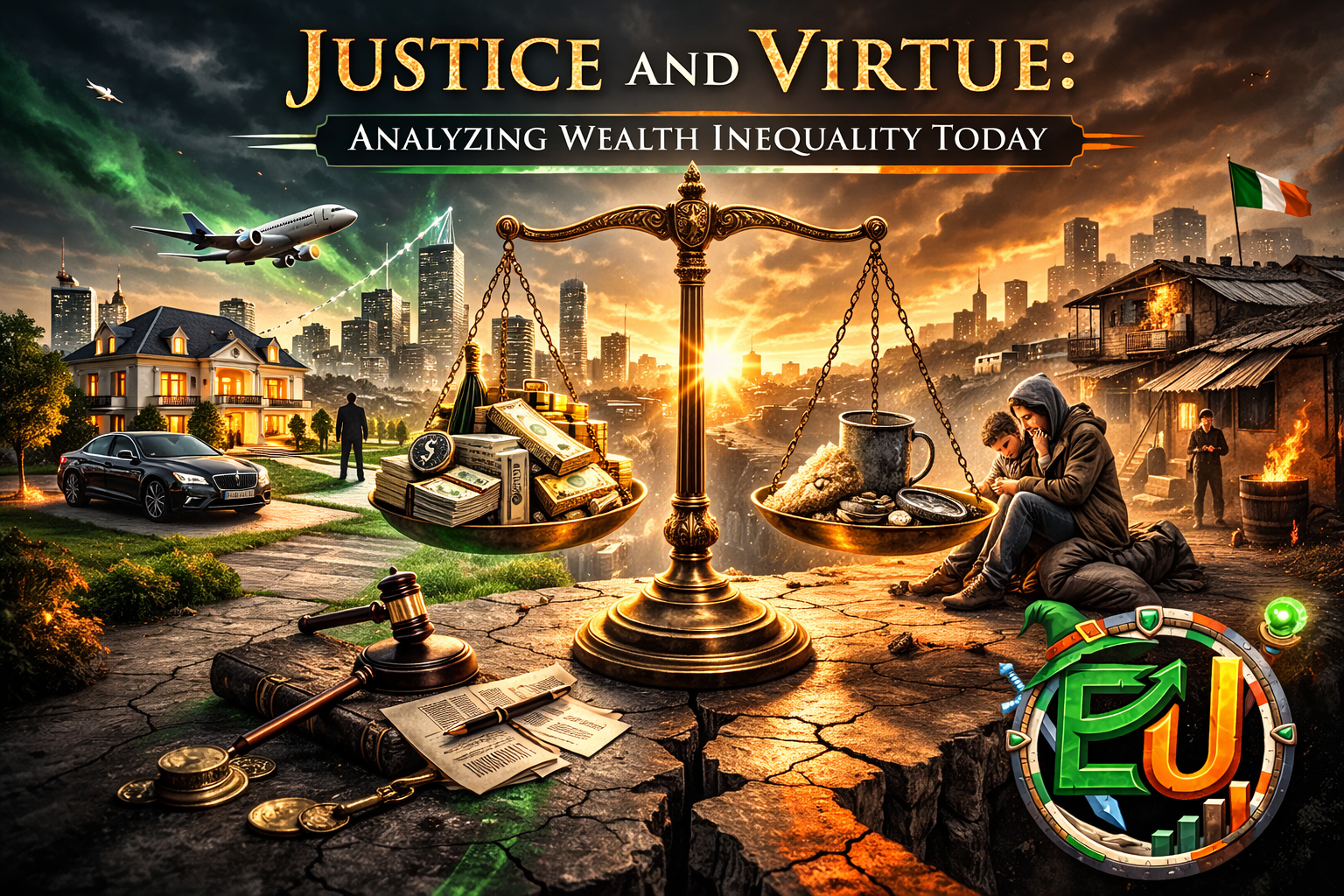
Wealth inequality is a modern-day economic crisis, especially in America. The US exhibits more wealth inequality and disparities than any other developed nation. The top 1% hold over a third of the nation’s wealth, while the bottom 50% hold just three percent of the nation’s wealth[1]. Our laws and legal structure are situated in such a way that the easiest way to make a million dollars is to already have multiple million dollars, an approach that makes absolutely no sense for most citizens. This is a strategy explicitly designed and aimed to siphon money from the bottom and redistribute it to the top, with Wall Street serving as the primary mechanism facilitating this ongoing distribution. Stock buybacks and similar practices function as a financial strategy designed to distribute retained earnings to shareholders rather than reinvesting them in the workforce (who created the retained earnings), productive capacity, or enriching the community in which the corporation does business. The shareholder enrichment that results from this disproportionately benefits concentrated ownership at the top of the wealth distribution, such as institutional investors, billionaires, and their families for generations to come.
The reality of practices that overwhelmingly benefit the wealthy and take advantage of people of a lower socioeconomic status constitutes an ideal, practical situation to apply John Rawls’ veil of ignorance thought experiment. The veil of ignorance is an instrument used to convey justice as a means of fairness which Rawls believed. To accurately utilize the veil of ignorance we must first imagine that people choose principles of justice and create laws and regulations from an original position, meaning they do not know their income level, race or gender, talents or intelligence, or social class. Under this position, rational lawmakers would design society in a way that protects the poorest individuals in case they end up amongst them and guarantees basic economic security, provides equal access to education, and prevents extreme poverty. Rawls would potentially argue that extreme wealth concentration can distort political equality and erode democracy via disproportionate influence over legislation (this has been happening via deregulation and the swap to financial capitalism in the US since Reagan in the 1970’s). Additionally, Rawls may detest the known fact that wealthy families secure better education, networks, and opportunities, and the reduced economic mobility that results from this.
Micro Analysis
Rawls’ Justice Virtue can be applied to countless modern decisions and forks in the road that we encounter. One example of such a situation is ai automation taking jobs and potentially displacing workers, a path that is being heavily invested in by the wealthy and Wall Street with hopes of success. The veil of ignorance tells us that we don’t know whether we will be born a highly skilled ai engineer, a truck driver whose displaced by automation, or a warehouse worker replaced by robotics. The first question Rawls’ veil of ignorance may potentially conjure is whether technological gains such as ai benefit the least advantaged? Technological advances have been extraordinary over the last few decades, and they have led to a massive boom in worker productivity. Productivity in the US has increased by over 90% since 1979, meanwhile, pay has only increased 33% in that same period[2]. Now, with the introduction of ai, workers risk losing their jobs completely. Due to such massive productivity gains and marginal pay increase, as well as the average citizen having minimal healthy use cases with ai, and the current primary use being the generation of fake videos on social media intended to waste time and infuriate the user, Rawls may ultimately conclude that these technological gains do not benefit the least advantaged, and in fact take advantage of them in the form of social media and other short-term gratification frameworks which are exceedingly common today.
Another valuable insight that Rawls’ veil of ignorance may offer is the question of whether workers displaced by ai are protected by any sort of institutional safeguards such as universal basic income or government regulation on automation. Ai growth and worker displacement will disproportionately harm individuals with less access to education, geographic immobility (with limited job opportunities), and limited advancement resources. Additionally, as of this writing, government regulation on ai is minimal (including environmental factors such as extreme water use), and there are nominal social safety nets. These factors would likely lead Rawls’ to conclude that workers displaced by ai have no governmental assistance (we have been raised to believe that government programs and social wage efforts do not work or are abused), and that affected workers don’t have guard rails against permanent economic exclusion and therefore it is unjust and unfair in its current framework.
Conclusion
The veil of ignorance and John Rawls’ Justice Virtue approach is an abundantly beneficial tool for rewiring how we think about fairness and the laws that result from the pursuit of justice. When we use it to analyze modern systems that plague us, we find that our economic approach has become increasingly unfair over the last handful of decades. Despite this distressing news, we can make better ethical decisions and become more involved global citizens in the fight for equality and justice. When we think about the world of the future, we should imagine one that allows equal opportunities to prosper for all, and we should create the foundations for society that allows this to become reality. Although equal opportunity is a foundational norm in American labor conversation, as we have seen, persistent disparities in outcomes indicate a gap between formal commitment and substantive practice.
Thank you for reading my blog post! Please feel free to connect with me at any of the links below or subscribe for email updates. Lets make the world a better place one conversation at a time.
https://www.youtube.com/@Econ_Unpacked
Contact email: econunpackedinquiry@gmail.com
Sources
Hillard, M. (2025, November 5). Wealth Inequality Presentation. Portland.
The productivity–pay gap. Economic Policy Institute. (2026, January 16). https://www.epi.org/productivity-pay-gap/
Buchler, E. G. (2026, February 23). Will artificial intelligence make human workers obsolete?. The Hub. https://hub.jhu.edu/2026/02/23/will-ai-make-human-workers-obsolete/
Wenar, L. (2025, September 3). John Rawls. Stanford Encyclopedia of Philosophy. https://plato.stanford.edu/entries/rawls/
[1] Hillard, M. (2025, November 5). Wealth Inequality Presentation. Portland.
Leave a Reply